
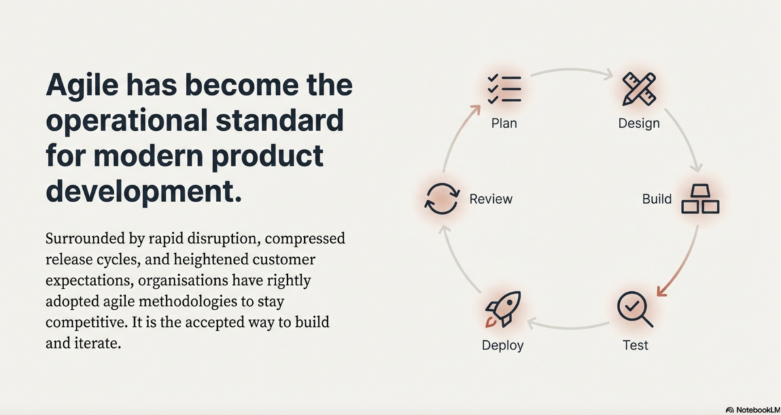
Surrounded by rapid disruption, compressed release cycles, and heightened customer expectations, agile product development has become the operational standard. Yet agility is only as strong as the information ecosystem that fuels it. Organizations cannot iterate, prioritize, or de-risk decisions without real-time clarity into what customers value and why.
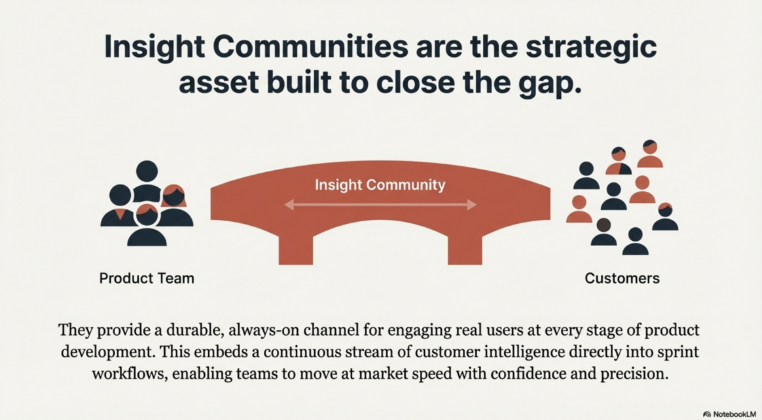
This is one area where insight communities are a strategic differentiator. They provide a durable, always-on channel for engaging real users at every stage of product development, enabling teams to move at market speed with confidence and precision.
The Market Reality
Modern product development requires sustained proximity to the customer. Organizations cannot rely on episodic research cycles or intuition-driven decision-making. Instead, high-performing teams embed customer intelligence directly into their sprint workflows.
This aligns with broader industry perspectives on continuous improvement. As Productboard notes, “customer feedback fuels continuous product improvement… ensuring that products remain relevant, user-friendly, and aligned with customer needs.” This reinforces the strategic requirement for teams to maintain an uninterrupted feedback loop that informs every phase of development.
Three forces make this shift critical:
- Accelerating customer expectations driven by personalization, convenience, and cross-channel consistency
- Increasing product complexity as digital experiences, ecosystems, and AI-powered capabilities expand
- Rising internal pressure for efficiency as teams are asked to do more with tighter timelines and fewer resources
To keep pace, teams must reduce the latency between insight and action. Communities deliver precisely that advantage.
Why Insight Communities Are Purpose-Built for Agile Product Development
1. Always-on access makes iteration frictionless
Agile methodologies require rapid validation. Whether teams are refining requirements, testing prototypes, or evaluating usability, they need direct customer input at the moment of decision, not weeks later.
Insight communities offer:
- On-demand recruitment from a known, engaged audience
- Fast-turn qualitative and quantitative testing
- Longitudinal visibility into how expectations evolve
These capabilities align closely with industry observations. Insight Platforms notes that community-centered research delivers “faster, more actionable results” and enables companies to “test, validate, iterate, and co-create strategies with users.” This reflects the operational value of shifting from episodic studies to a continuous, community-powered feedback engine.
This removes operational bottlenecks and allows teams to move from assumption to evidence in hours instead of weeks.
2. A consistent audience strengthens signal quality and accelerates learning
Most research challenges stem from variability in sample quality. Communities solve this by maintaining a dependable cohort of deeply profiled, highly engaged participants who understand the brand, the product context, and the vision.
This consistency enables:
- More reliable comparative testing
- The ability to spot emerging shifts earlier
- Greater trust in the insights feeding roadmap decisions
What was once episodic learning becomes continuous intelligence.
3. Communities future-proof research as third-party data becomes less reliable
The reliability of third-party data has deteriorated materially. Beyond shrinking access due to privacy restrictions, organizations are now facing systemic issues of data fraud, identity misrepresentation, and low-quality responses across third-party panels and data providers. These risks undermine decision quality and create operational exposure for product, insights, and marketing teams.
Insight communities provide:
- Compliant, transparent, permission-based engagement
- Direct relationships grounded in trust and verified identity
- Access to richer qualitative and behavioral insight unavailable through passive or purchased data sources
Organizations that shift toward owned, first-party insight channels will be structurally advantaged in an increasingly privacy-centric, fraud-prone data environment.
4. Communities amplify emotional, behavioral, and experiential understanding
Modern product innovation extends beyond functional requirements. Teams must understand emotional triggers, friction points, workflows, motivations, and moments of delight.
Communities empower companies to:
- Observe real reactions to prototypes and concepts
- Identify the “why” behind user preferences
- Capture subtle feedback not visible in survey-only research
This depth of insight elevates product-market fit and supports differentiated experiences.
5. Shared Truth Accelerates Cross-Functional Alignment
Agile product development breaks down when teams operate in silos. Communities create a shared source of truth that unifies product, UX, CX, data science, and go-to-market organizations around the same insights.
This alignment results in:
- Faster prioritization
- Clearer trade-off decisions
- Stronger cross-functional execution
Teams no longer debate opinions; they act on customer evidence.
How Leading Organizations Operationalize Insight Communities Across the Product Lifecycle
During Discovery
Identify unmet needs, validate problem statements, and assess emotional drivers.
During Ideation
Pressure-test concepts, compare value propositions, and refine experience direction before investing in development.
During Delivery
Run iterative usability tests, evaluate design decisions, and identify friction before launch.
During Measurement
Assess product performance, capture post-launch sentiment, and continuously inform roadmap optimization.
Communities allow this lifecycle to operate as a closed-loop system rather than a disconnected sequence of events.
The Strategic Bottom Line
Agile product development is no longer optional—it is the operational backbone of modern, customer-centric organizations. But agility without insight is simply speed without direction.
Insight communities equip teams with:
- A continuous pulse on customer needs
- Rapid access to high-quality participants
- Emotional and experiential understanding
- A unified source of truth for cross-functional teams
- Reduced risk and increased confidence in every product decision
These outcomes are reinforced by broader industry data. A Modstud analysis found that companies embedding structured user feedback into their development lifecycle achieve 20–30% improvements in customer satisfaction and reduce time-to-market by up to 25%. This underscores the operational and experiential gains that community-powered insight ecosystems enable.
For organizations striving to accelerate innovation while staying tightly aligned to customer reality, communities are not just a good fit. They are an indispensable strategic asset.